Shoutout to the ones that changed my life
I spent so much of my life since childhood dreaming up imaginary spaces then later turning that passion into becoming an architect. My favourite pastime would be to escape in my father’s library in the basement. Surrounded by hundreds of books allowed me to immerse myself in a magical world of awe and knowledge. Ranging from encyclopedias to the great classics, cookbooks, poetry, Shakespeare, philosophy, sociology and psychology. There was never a day my curiosity led me astray, it contributed to my vivid mindscape.
Little did I know at the time how grateful I would be for my father’s library and how much of an impact it had on my sister and me. I revered their minds, passion and demeanour within otherworldly thinking. I could listen to my Father’s and sister’s discussions for hours. It is only in hindsight how much I realized how their being and books shaped the person who I am today.
Their libraries were their legacy, which had a direct impact on my life transformation today. Their passing not only led to my newfound calling in deathwork but reignited my passion for books. Deathwork led me to beginning a new chapter in my life to understand as much as there is to know about grief and death. This led me to enroll in a course as a death doula and subsequently funeral director class 1 embalming education. I began my journey in wanting to educate myself on grief, the process of end of life , and caring for the deceased, I realized in losing both my father and sister shone a light on how ill-prepared I was in supporting the dying and being among the deceased.
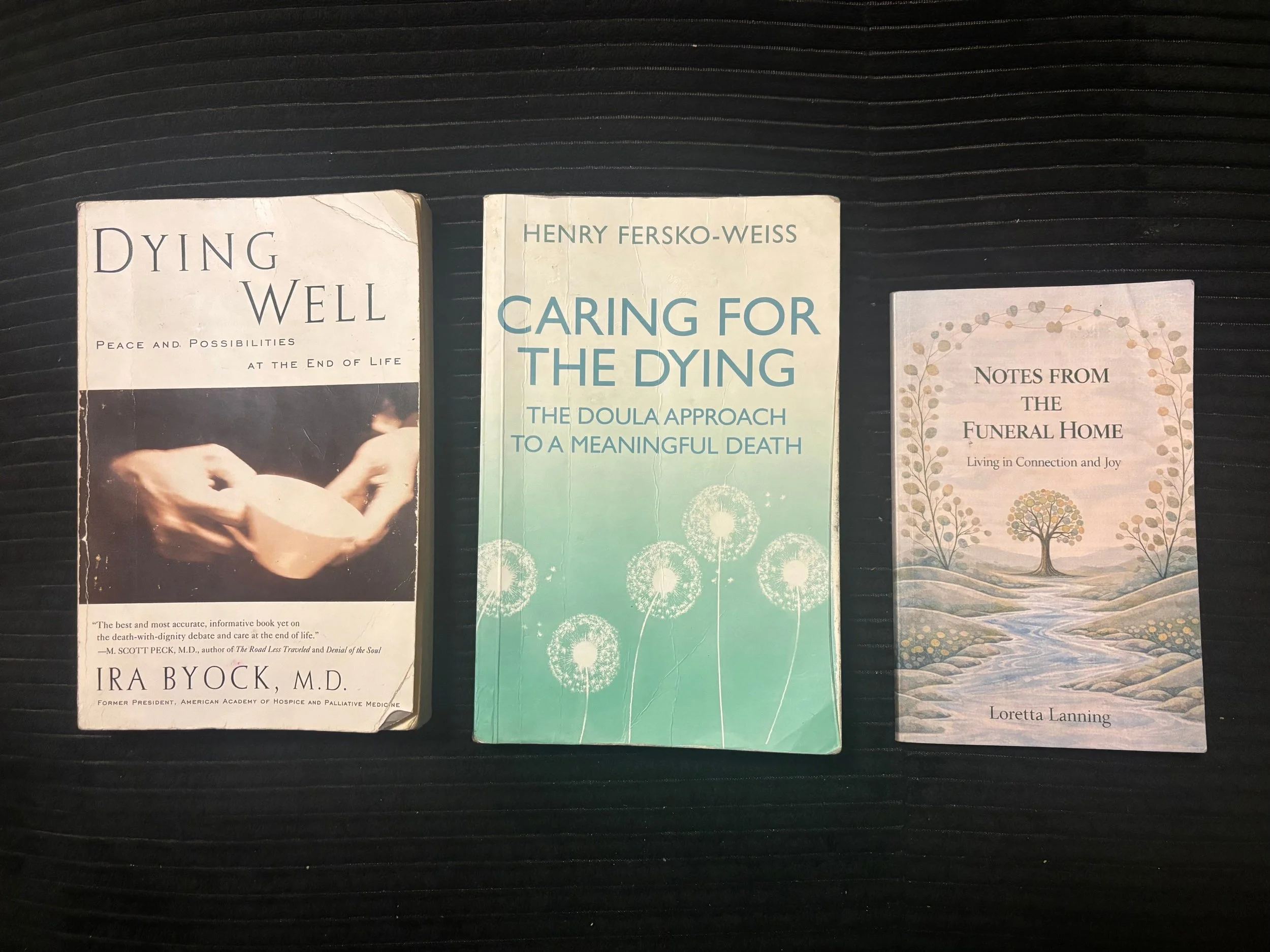
The death care books that were intrinsic to the end of life doula course were profound and changed my way of thinking and being. Never before in my life did any book not only educated me but also resonated deeply with my heart and soul. In the completion of each of the books, a portal to the divine opened that was necessary to integrate.
The following three books covered different areas within Deathwork and the common theme in each was love, compassion and community. The first book that I read was entitled “Caring for the Dying - The Doula approach to a meaningful death by Henry Fersco-Weiss. From the title itself, this book spoke to the concept of the death doula and the importance and role of doula care at the end of life. The author himself played a major role in the origin and education of this newly developed industry. He spoke to the death doula as being an integral part in filling the gaps that don’t exist within healthcare for the dying and their loved ones.
In reading this book, I came across ideas and concepts that I never have before such as being with the dying and confronting the challenging situations surrounding death is something I never knew how to approach. I had the realization that it was not only me who was alien to this but many others. I never thought it possible to see death as a sacred passage through ritual, meaning and legacy.
Henry described the doula method as a three part approach which includes:
Planning toward and envisioning the end of a dying persons life.
Holding space for the dying while ensuring the end of life vision is executed.
Reprocessing the death and grief work with the loved ones.
The book beautifully opens new ideas of healing methodologies for the dying and loved ones such as reflections on life meaning and legacy through deep active listening, creative rituals, meditation, visualization and tender touch. Unpacking and processing grief of the dying and their loved ones as well as lending a hand to the logistics for the dying and their loved ones in community and connection. With particular focus and advocacy for on fulfilling the end of life wishes and comfort prior to their death. This book altered my perspective completely on dying in seeing in as a process toward surrender and acceptance.
The stories that stood out to me were the messages of love and memories that people shared of their loved ones with the dying and read amongst themselves after they died
Stories of careful attention to the layout and design of the environment and room from the types of bedding to the scent, lighting and placement of the bed where the dying could spend their final days gazing out at the sunlight and into the clouds through the trees.
To the nature visualizations that calmed and eased the dying mind such as carefully curating visualizations of nature and water.
The book “Dying Well - Peace and Possibilities at the End of Life” by Hospice Doctor Ira Byock talked about there being no such thing as the “good death” as it presents as too formulaic. This is why he opted for the term “Dying Well” for the process of each dying individual comes with a subset of unique characteristics. He believed in the possibility of growth and transformation at the end of life which results in undergoing landmarks and taskwork. Not only did these lead to personal growth but to extraordinary healing and self mastery through healing oneself and relationships. This taskwork consisted of a basic yet powerful script which entailed saying “ I forgive you”; “Forgive me”; “Thank you”; “I love you”; and goodbye. Such was the essence of courage and basis of life’s final completion.
Dr. Ira explained the shortfalls of the medical system and how meaning is often bypassed. He believes that the source of change begins with a cultural shift in attitude toward death. Change begins with us, to not be afraid to talk about death openly and honestly. The stories that particularly shone were:
An 8 year old boy who was dying that had a spirit so bright that it was larger than life. Although he was severely limited in many ways his essence exuded love and brought community together with expressions of love.
A young mother whose resistance to dying and pain medication suffered in pain till her very end showed fierce commitment and dedication to her children and husband. In her refusal to let go she succumbed to death by way of sedation, it was the only path to passing peacefully.
A woman who surrendered to her death after learning of her late stage brain cancer prognosis lives her final days in appreciation toward her life and family. Relishing in the joy of life’s smallest pleasures.
The book “Notes from the Funeral Home - living in Connection and Joy by Loretta Lanning was a pre-planner and arranger who talks about how much courage it takes to be alive and plan for one’s funeral. It is the space where she bears witness to the moments when people realize their mortality and faces life beyond their death. Many pre-planners believe that paying and planning for your funeral is one of the greatest gifts to give your loved ones as it essentially for them and their closure. Pre-planning allows loved ones to focus on grieving and healing rather than scrambling to plan a funeral while feeling immense grief.
In the arranging room she discusses it as a place to hold space for truth telling along with strong emotions. Many stories are shared there about lives of the deceased as well as family members that bring with it. She iterates the importance of living in connection and community for they are the foundation that shows up after death and share their Loved ones legacy.
She speaks to one of the biggest roles of a funeral home which is caring for the deceased. She iterates the importance of caring for bodies as it is the sacred temple that housed souls during our lifetime. This book resonated deeply as I am currently registered as a student to become a funeral director.
When your whole heart and soul resonate with the legacy of books and you share a deep calling as well as a connected vision to them, your transforms and transcends reality.